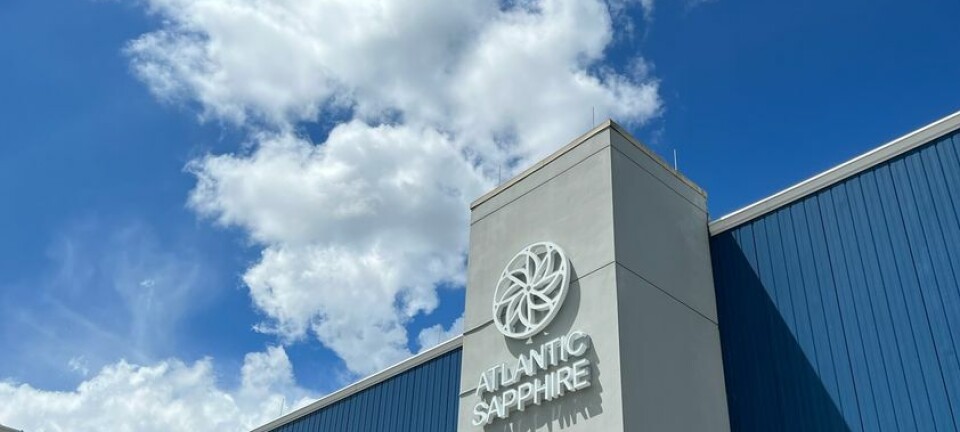
Happier times: pictured at Atlantic Sapphire's listing on the Oslo Stock Exchange on May 5, 2020 are then board member Tone Bjørnov and then chief financial officer Karl Øystein Øyehaug. The company now intends to delist.
Photo: Atlantic Sapphire
Atlantic Sapphire plans to delist as part of refinancing strategy
The United States salmon farmer has entered into an agreement that will secure at least $20 million in new liquidity. The solution also includes a voluntary offer to shareholders, a write-down and conversion of debt, a private placement and a planned delisting from the Oslo Stock Exchange.
Atlantic Sapphire announced in a stock exchange filing that the company has entered into a restructuring agreement with a group of the company's largest shareholders and lenders. This investor group consists of companies such as Nordlaks Holding, Joh. Johannsson Eiendom. Condire Management, Nokomis Capital and Strawberry Capital.
According to the announcement, the group represents approximately 63% of the shares in the company and 93% of the outstanding convertible loan. In addition, Coral HoldCo AS, a joint investment company established by the above-mentioned investor group, is a party to the agreement.
The restructuring will contribute a minimum of US $20 million (£14.8m) in new liquidity to Atlantic Sapphire, which farms Atlantic salmon at its Bluehouse landbased facility at Homestead, south of Miami, Florida.
The liquidity includes a previously announced $10m bridge loan. At the same time, the balance sheet will be strengthened through a partial write-down of the convertible loan and subsequent conversion into shares for lenders who choose to participate.
Voluntary offer, then compulsory redemption
As part of the solution, Coral Holding will, according to the stock exchange announcement, make an offer for all shares in Atlantic Sapphire at a price of NOK 0.80 per share.
Following completion of the transaction, the company plans for Coral Holding to be able to forcibly redeem remaining minority shareholders at the same price. Furthermore, it is planned that both the shares and subscription rights in Atlantic Sapphire will be delisted from the Euronext Oslo Stock Exchange.
Loans are converted
The bridge loan will be transferred to Coral Holding and then converted into new shares in Atlantic Sapphire at a price of NOK 0.10 per share.
The convertible loan will also be amended. Lenders will be given the right to convert their share of the loan, including accrued and unpaid interest, into shares at the same price of NOK 0.10. This assumes that the lenders accept a write-down of 23% of the outstanding amount.
The investor group, which controls 93% of the convertible loan, has already accepted the write-down and conversion.
Private placement of up to $16 million
The agreement also includes a private placement in three tranches, with gross proceeds of up to approximately $16m. The issue price is set at NOK 0.10 per share.
The first tranche is fully subscribed by the investor group and is expected to raise approximately $10m. The second tranche is directed to other lenders who convert the convertible loan, with possible gross proceeds of up to $750,000m.
The third tranche is aimed at former shareholders who accept the voluntary offer. They may be given the opportunity to participate with up to $5.85m, but must, among other things, buy back the shares they sold in the offer at the same price of NOK 0.80 per share. A minimum subscription of NOK 100,000 is also required.
'Significant risk of further cash needs'
Atlantic Sapphire notes in its stock exchange filing that the company's liquidity needs have been communicated several times throughout 2026. In February, the company stated that it needed $15-25m in new capital. This was later updated to $25-30m.
The company writes that there was an urgent need for liquidity to meet ongoing obligations, maintain operations and avoid insolvency processes. Directors believe, based on advice and dialogue with the investor group, that there were no realistic alternative financing solutions.
The board also points out that the company's liabilities, in their assessment, probably exceed the value of its equity. This is cited as the reason for writing down the convertible loan before conversion.
At the same time, it is emphasised that the restructuring does not necessarily cover the company's entire financing needs for the next 12 months. Atlantic Sapphire writes that there is still a significant risk that the company will need additional equity, especially if the later tranches of the issue are not fully subscribed.